Phew. Done. At least for a while.
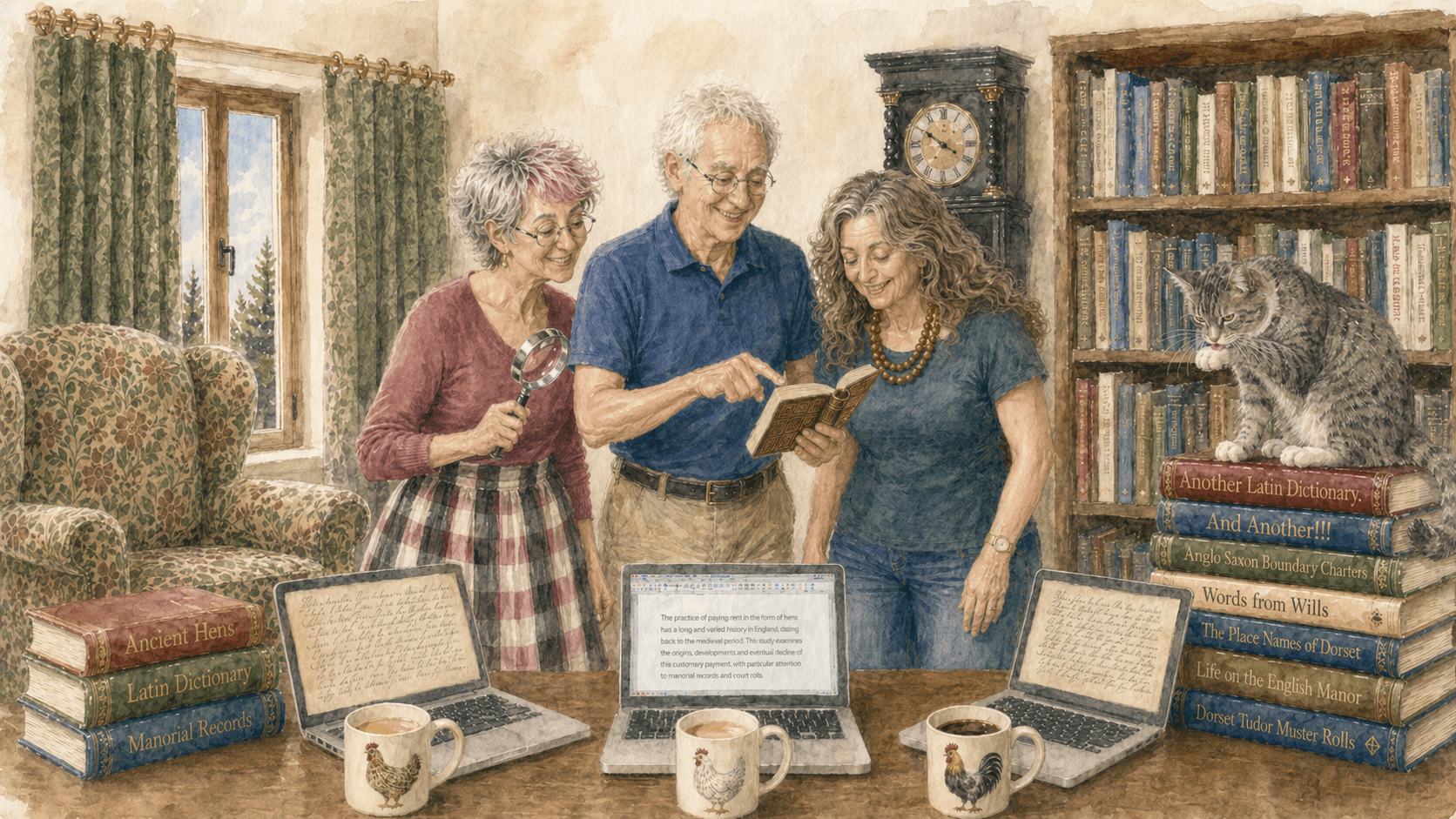
It seems a long time ago (October 2022), when there was a brief, uncharacteristic, silence. Three of us had just finished transcribing and translating nine Latin manorial court rolls for Stalbridge manor.1Available at Dorset History Centre (ref RON/2/2/Stalbridge/18), Hertfordshire Archives and Local Studies, and Stalbridge History Society. We celebrated with a rare in-person meeting – most work had happened via weekly Zoom sessions – and when the three of us are together, at least two of us are usually talking. Most often, Helen and Claire.
The silence broke: ‘I presume we should go on and do Weston?’
I hesitated. Did we really have the drive? The energy? Weston meant over sixty court sessions. Not six. Sixty. But I knew better than to question two formidable friends, and it gave Claire an excuse to buy a few more hefty Latin reference books (and, as it turned out, some Anglo-Saxon ones as well).
So, we did it. It took over three years working very much part-time. The finish line was staggered as we organised work around our individual skills, with some tasks completed before others, leading to workloads that were uneven.
Work expands to fill the time available for it, and we certainly found interesting ways to fill the time. Early on, we decided to create a dedicated website, allowing us to enter the information directly, and to make it as widely available as possible.
Then: just a little bit of project scope creep. We gathered and summarised facts from wills, probate grants and household inventories from the same period as the court rolls. The archive catalogues of wills are based largely on recording the individual’s parish, but inspection of the original texts identified several people who definitely lived in Stalbridge Weston. Suddenly we had richer detail, a fuller picture. It would add interest to the website.
Then came snippets on lords of the manor. Obvious questions pulled us deeper. We discussed developing a brief overall history, so more scope creep. Helen dived in, taking the lead, supported by yours truly doing the grunt work of first-pass translations and transcriptions. There was ferreting out details from multiple sources. Irene Jones’s book2Irene Jones, The Stalbridge Inheritance From Roman Times to the late Eighteenth Century (Dovecote Press, 2009). gave initial signposts, but we had the luxuries of time, later technology and a tighter focus that weren’t available to her. We tried to limit the number of rabbit holes we went down, but what we found meant that was a futile hope. Supporting each other was essential as the manor history threatened to (and then did) dominate the project’s final stage.
Online searches and visits to archives revealed surprising bits of history about the manor ownership, disagreements, a riot or two, even litigation in the highest court of the land. One let-down was the dearth of records for earlier centuries – plus the difficulties in reading what had survived. Still, we persisted. We inspected many original documents, including the particulars of Weston manor when Henry VIII sold it into private ownership after dissolution of the monasteries. It was genuinely exciting to lay our hands on a document from such an important period of history. We coped with text in secretary hand (the spiky, abbreviated Tudor script that gives palaeographers nightmares) and what seemed several wild handwriting variations. And of course, yet more Latin and a little Anglo-Saxon.
The result is a brief manor history set against the national background, from Saxon times until its sale to Peter Walter in the early eighteenth century. Although written in a slightly light-hearted style, it’s well worth your time to read. It’s complete with references (experience has taught us to be cautious of research without citations), so if you want to see the sources for yourself, you can. Reading the history you’ll encounter one or two surprising characters and facts.
Are we finished?
No, although other unrelated projects are demanding attention. There may be errors and certainly omissions in what we’ve done so far. Despite transcribing / translating over 150 documents, there are records we haven’t examined in detail (yet), and who knows – further records might surface tomorrow which either fill gaps or provide a different insight on events. But we want to make this first tranche of our work available to others now.
Dave Harris
References
- 1Available at Dorset History Centre (ref RON/2/2/Stalbridge/18), Hertfordshire Archives and Local Studies, and Stalbridge History Society. ↩︎
- 2Irene Jones, The Stalbridge Inheritance From Roman Times to the late Eighteenth Century (Dovecote Press, 2009). ↩︎