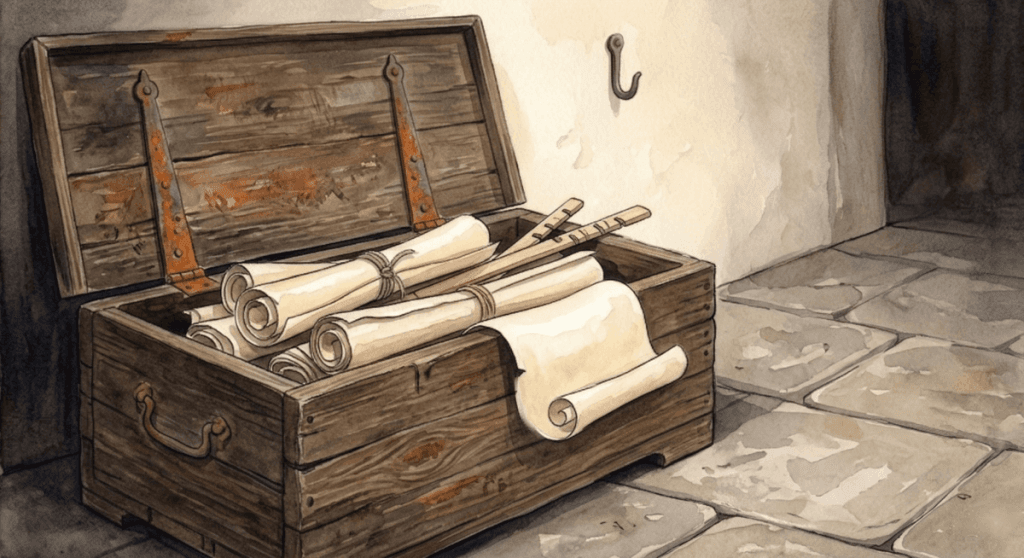
Sixty-odd court rolls survive for the manor of Stalbridge Weston from the seventeenth and early eighteenth century: two Jacobean parchments from 1611 and 1612 under George Thornhull, and an apparently continuous run from 1663 to 1716 under the Whitchurches. Between them, they record the day-to-day legal life of the manor across more than a century, and they give us names, rents, holdings and disagreements for a community that, except in the wills, would otherwise be silent before the parish register begins in 1690.
absentee lords and Their Manor
The lord of the manorThe Lord of the Manor was the landowner with legal and economic control over a manor. They collected rents, administered... In full. was the legal apex of this little world, but he was not always very close to it. George Thornhull, who presided over the 1611 court in the ninth year of James I’s reign, held Stalbridge Weston at the turn of the seventeenth century. By 1663 the manor had passed through Edward Thornhull to the first of a succession of William Whitchurches (see the History page for the full family) who held it from their home at Frome Selwood in Somerset. The Whitchurches added the neighbouring holding of Antioch in 1701 (from the 1709 court onwards the heading reads ‘Manor of Stalbridge Weston and Anteox’), and other evidence shows a William Whitchurch still lord as late as 1718. Our run of rolls stops in 1716; the missing two years are almost certainly an archival loss rather than a change of ownership. Across that whole period there is not a single entry that says a Whitchurch was actually present at one of his own courts. The business was done by his SeneschalThe seneschal was the principal legal and administrative officer of a manor, representing the lord's authority. By the seventeenth century,... In full. (for example, Thomas Napper in 1663, and James Wickham by 1709).
The court ran on a tension. The lord wanted what the manor owed him: rents, finesA fine was a customary payment made to the lord of the manor upon changes to tenancy arrangements. It acknowledged... In full., heriotsHeriot was a duty the lord of the manor collected at the end of a tenancy. It traditionally consisted of... In full., the enforcement of customThe rules, rights and obligations by which a particular manor was governed/administered. These customs acquired legal force through long usage... In full.. The tenants wanted to keep their land, their rights of commonLand over which manorial tenants held shared rights. These typically included common of pasture (grazing), turbary (cutting turf for fuel),... In full. and their good standing with the neighbours. The Seneschal was there to see that the lord got his due. He opened the court, swore in the homageHomage referred to the sworn body of tenants who served as the jury of a manor court. Selection for the... In full. and, crucially, had his scribe record the day’s decisions.
The same families, again
Anyone who has read the probate pages on this site will recognise the names on the homage almost immediately. The 1663 juryHomage referred to the sworn body of tenants who served as the jury of a manor court. Selection for the... In full. includes William Thornhull, Robert Joyliffe, Bernard Chamberlaine, Robert Clarke, Thomas Cooke, John Snooke, Robert Kember, Robert Hobbs, Robert Hellier, John Chaffey, Thomas Snooke, John Carter, Laurence Hobbs, Robert Langman and George Hancock. Almost every one of them either left a will, is named in someone else’s, or turns up appraising a neighbour’s goods.
And the rolls themselves run on those same families: surrenders within a family as one generation makes way for the next, transactions across families as tenements change hands by marriageJure uxoris ('by right of wife') was how a husband gained rights over his wife's property. In the English property... In full. or by reversionThe automatic transfer of a tenancy upon the termination of the current tenant's interest. In manorial practice, reversions were commonly... In full.. In the 1701 court, Robert Kember junior walks in and takes the reversion of his parents’ tenementA tenement was any holding of land with at least one building. A customary tenement was held according to the... In full., on the lives of himself and Susanne Pope of Ockford Fitzpayne (very likely his bride-to-be). The grant runs to eleven named closes, a coppiceA coppice was a managed woodland where trees were periodically cut back to encourage new growth. Coppicing produced a renewable... In full. and communal pasture for forty sheep. Annual rent: 19s 4d, plus two hens at Martinmas. HeriotHeriot was a duty the lord of the manor collected at the end of a tenancy. It traditionally consisted of... In full.: 90s. FineA fine was a customary payment made to the lord of the manor upon changes to tenancy arrangements. It acknowledged... In full.: £80, paid the same day. The field names are as precise as any modern title deed, and the family lines are written across the parish boundary.
What the rolls cannot tell you is what was inside the house. Read the rolls alongside the wills and the two sets of documents start answering each other’s questions. A widow admittedAdmission was the legal process granting a new tenant rights to copyhold property. The court 'admitted' someone following a previous... In full. as ‘next taker by right of custom’ in the court roll appears a few years later as an administratrix in the probate records. A copyholdA form of land tenure where the tenant held land 'by copy of court roll'. The manorial court roll recorded... In full. tenement that a testator bequeaths to ‘my son William, after my decease’ can be traced forward into the next generation’s court entry, where William is formally admitted and pays his fine. Where probate shows you the inside of a house, the court rolls show you the land that went with it. That land did not pass through the probate system at all (although the crops on it did). A copyhold tenement was held of the lord, and on a tenant’s death it descended through the manor courtThe court of the manor itself, where copyhold land changed hands, tenants were admitted and amerced, and the custom of... In full. by surrenderSurrender was the formal procedure of returning a copyhold tenancy to the lord of the manor. It served several purposes:... In full. and admissionAdmission was the legal process granting a new tenant rights to copyhold property. The court 'admitted' someone following a previous... In full., not by will. That is why you will so often find a man’s goods and chattels in one set of records and his holding in the other.
Heriots, fines and the price of dying
The copyhold system ran on three kinds of payment and the rolls record all of them. The annual rent was modest — a few shillings on a small holding, 16 shillings on Langman’s seven enclosures, 12 shillings on a cottage newly built on the wasteThe lord's waste referred to uncultivated land within a manor not held by tenants. These were typically open, unimproved lands... In full. at Eastop Lane in 1686. The fine was the lump sum paid on entry, and it was where the lord made his real money: 60 shillings for Langman’s regrant, a startling £60 from James Carter in 1701 for the reversion of his father’s three-acre cottage near Northwood, £18 10s from Francis and Thomas Cooke for the reversion of the enclosure called Stephen Forde. The heriot was the death duty. When Laurence Hobbs died between the 1671 and 1672 courts the lord took his best beast; the homage recorded it plainly as ‘an ox prized at three pounds and ten shillings which is paid’. When Thomas Farvis died the same year the rolls simply say the heriot was ‘the best goods of the tenant deceased’, with the valuation still to come.
For the families involved these were serious sums. £60 to be admitted to three acres and a cottage in 1701 is the price of a modest inventory in full. Copyhold land was secure, but it was never quite yours.
The rights and Obligations that came with the land
A copyhold at Stalbridge Weston came with a bundle of customary rightsThe rules, rights and obligations by which a particular manor was governed/administered. These customs acquired legal force through long usage... In full. (appurtenancesThe legally recognised rights, privileges, and physical elements inseparably attached to a property within a manor. These included both beneficial... In full.) over the shared resources of the manor, on top of the house and the enclosures themselves. The rolls are full of those rights being exercised, defended, written down, and from time to time argued over.
The biggest of them was common of pasture. Tenants could graze a set number of animals on the commons of the manor, and the rolls are unusually explicit about how many. A grant in 1666 attaches to Edward Hellyer’s tenement ‘communal pasture for twenty five sheep in the common land called Stalbridge Weston common’; a 1677 surrender-and-regrant names ‘communal pasture for two draught beasts’; a 1684 reversion of a sixty-acre tenement comes with pasture ‘for one hundred sheep’. A 1685 grant uses the old Dorset phrasing ‘for two beasts called Rother beastsHorned cattle, specifically oxen and cows, as distinguished from other livestock within the manor. The term derives from the Old... In full. or for twenty sheep’ — with the implicit conversion that one rother (cattle) beast is worth ten sheep on the common. This is stinting: the common was not a free-for-all, and every tenant knew exactly how many head they were entitled to put on it.
Overstepping that allowance was a standing court matter. In 1666 Edward Hellier was presented ‘for over pressing [using] the Commons’; in 1668 Ambrose Browne for ‘oppressing the common’ by taking in sheep and horses; and an almost identical presentmentPresentments constituted the formal declarations and findings submitted by the Homage at each sitting of the manor court. The Homage... In full. appears year after year from 1679 onwards: ‘if any man take in any agistmentAgistment was an arrangement whereby landowners or tenants permitted others to pasture their livestock on lands for a specified fee.... In full. sheep they are not to lodge nor couch in our Common’, on pain of'On pain of' was a phrase in presentments specifying the penalty for non-compliance with a court directive. When the court... In full. 3s 4d for every offence. Agistment — letting grazing rights out to someone else’s animals — was where outsiders tried to squeeze onto the common through a back door, and the homage clearly regarded it as a permanent running sore.
Next in importance were the rights of estovers: the right to cut wood from the manor’s woods for specific household and farming purposes. The rolls distinguish these carefully. A 1673 grant gives the tenant ‘plough-boot and gate-boot being timber, not making waste’; a 1685 entry grants ‘one timber tree for the repair of his tenement’; a 1666 surrender-and-re-grant to William Loder gives him the right to draw timber ‘for repairing of our houses out of Freth Wood and to have the [right of] way’. Furze — the gorse that grew on the common and was used as fuel and kindling — was similarly protected: in 1671 the homage presented ‘that none shall cut furze in the common but the tenants’, which is the court trying to stop cottagers from outside the manor helping themselves.
Rights of way across neighbours’ land and through the manor’s woods come up again and again. A 1663 grant promises its holder ‘the way through Rewthornes and Woollans’; a 1666 entry adds ‘Freth House’; a 1669 grant mentions ‘the customary way’ in Frith Wood. When those ways were blocked the court heard about it: in 1665 Mistress Parlett was presented for having ‘cut off the way in Yonder Lies’; in 1682 Joan Chamberlaine was presented for denying Robert Langman ‘his way to Bornmeade’; in 1686 Edward Hellier was presented for making an unauthorised way straight through William Kember’s four acres. These are the minor border wars of a village that depended on knowing exactly whose feet could cross whose field.
Water mattered too. A 1665 presentment names a tenant for holding up ‘the water in the Street at the Causeways End to the annoyance of passengers and detaining of the water from Grace Snooke widow’ — a small piece of domestic plumbing that mattered enough to go to court. A 1681 grant carries with it ‘free use of the spring belonging to the same tenement’. And the pound (the fenced enclosure for impounding strays) was the lord’s responsibility to maintain, which did not stop the homage presenting in 1673, 1680, 1681 and 1686 that the pound door was in decay and ‘ought to be amended by the lord of the manor’. They were still trying in 1687.
Below the rights sat the ordinary running repairs. The 1611 court presents a brown-and-blue horse foal found straying, worth 5s, now in the custody of Robert Pearce. It presents tenants from neighbouring Sturton Caundle — Bennett the cleric, Ellena Hill widow, John Calpin — for allowing too many animals on the common. It names William Snooke, William Chamberlen and Agnes Tiler, ‘tenants of cottages newly erected’, with Nicholas Ploughman, subtenant of Richard Lane, for cutting furze and wood they had no right to. And it orders Joan Fill, widow, to repair her barn by the feast of St John the Baptist on pain of 10 shillings. Sixty years later the same kinds of small troubles are still coming before the court: Elizabeth Hellier for her ruinous barn in 1672, Nicholas Farvis in 1677 for erecting a cottage on the waste and enclosing part of it (which he was ordered to ‘throw open by the next court’), Andrew Loder in 1687 for his hedge at Walbridge. The rolls are about as close as you can get to a village newspaper for this part of Dorset.
What the rolls do not show
The court rolls are a record of legal tenure, which means the people they show most clearly are the ones who held land from the lord. Labourers, journeymen, lodgers, servants, the children who had not yet inherited and the old who had already surrendered — all of them lived in the manor, and most of them barely touch the rolls. Women appear mainly as widows taking on a dead husband’s copyhold, or (like the 1611 widow Joan Fill with her leaking barn) as people being told to keep the place in repair. Court sessions were held only once or twice a year, and a lot of the ordinary life of the manor never needed the court at all. A quiet roll is not a quiet year.
What a manor court was for
A manor was both an agricultural estate and a small legal jurisdiction rolled into one, and its court was the place where the lord’s legal rights and the tenants’ customary rights and obligations met and were written down.
The law distinguished two kinds of business. The Court BaronThe manorial court that dealt with land and property matters. It handled admissions of new tenants, recorded surrenders and transfers... In full. dealt with the internal economy of the manor: the lord’s property rights and the tenants’ tenures, including admissions and surrenders, rents, fines, heriots, and the state of buildings and land. Where the lord possessed the franchise, a Court LeetThe manorial court concerned with law, order and local regulation. It appointed officers such as the hayward and affeerer, punished... In full. (with view of frankpledge) also sat, handling minor matters of policing and regulation such as strays, nuisances, assaults of a lesser kind, weights and measures, and the maintenance of shared resources and rights.
In theory these were separate courts with separate juries; in practice many manors, Stalbridge Weston among them, ran them together and did both kinds of business on the same day. The Weston court met once a year as a rule, occasionally twice, over the period 1663–1716 (with no courts, or no surviving records, in 1664 and 1675).
Who is on the page
Read past the opening formula and a standard cast of characters appears.
The lord is named at the top of every court (George Thornhull in 1611, a William Whitchurch from 1663) but there’s no evidence they were ever physically present. The Seneschal or steward is the lord’s working representative. The free suitorIn the manorial system, a tenant's obligation to attend the manor court was called 'suit of court'. Suit of court... In full. is a freeholder who owes attendance but holds his land outright – at Stalbridge Weston this was always a Weston of Callew Weston, owing suitIn the manorial system, a tenant's obligation to attend the manor court was called 'suit of court'. Suit of court... In full., occasionally being excused but most often being amercedAn amercement was a monetary penalty imposed by the court for breaching custom. The origin of the word reflects the... In full. a few pence for not showing up. The homage is the working jury of copyhold tenants, typically eight to a dozen of the most substantial men in the manor, sworn on oath to present everything that needs reporting. Later rolls also name a haywardThe hayward was a manorial official appointed to protect the fields during growing and harvest seasons. Duties included maintaining hedges,... In full. (such as John Carter, sworn in 1709), responsible for managing the common fields, the pound and the impounding of stray livestock. Where fines needed calibrating, two affeerersAn affeerer was a manor court official who assessed and adjusted amercement amounts. Selected from among the manor's tenants, affeerers... In full. – usually drawn from the homage itself – were appointed to set them at a fair level.
Everyone else on the manor who held land from the lord owed suit of court: they were expected to turn up. Legitimate absence could be ‘essoined’ (excused, usually for illness). Unexcused absence was ‘amerced’, meaning fined – often a token 3d or 6d, but a public mark against the tenant. Not all those who failed to appear at Weston were amerced every time. Those who were not fined may have made valid excuses that were not recorded.
How a court entry is put together
The rolls follow a fairly constant pattern. Each court opens with a formal heading: the manor, the lord, the date in both the king’s regnal year and the year of Our Lord, and (by the early eighteenth century) the name of the Seneschal. Then comes the attendance roll: free suitors, homage, essoins, tenants present, tenants absent, widows present, widows absent. Then the property transactions – the heart of the document – recording who surrendered what, who took what, on what terms, for whose lives, at what rent, with what heriot, for what fine. Then the presentmentsPresentments constituted the formal declarations and findings submitted by the Homage at each sitting of the manor court. The Homage... In full. from the homage: deaths since the last court, buildings out of repair, boundaries trespassed, rights reaffirmed. Then the closing material: amercements, the names of the affeerers, and sometimes a signature or two.
The 1611 and 1612 rolls are in heavily abbreviated Latin. The 1663–1716 rolls are a mixture: the formal legal business (admissions, surrenders, the regnal-year heading, the formulae of fine and heriot) is in Latin, while the presentments from the homage are in the English of the day, because that is the language the jurors spoke. What you read on the linked pages is a plain English summary, based on our own transcription and (where necessary) translation of the original. We’ve used the vocabulary of the time for words that have no simple modern equivalent, which also gives a better flavour of the original.
Copyhold, surrender and admission
The phrase that crops up again and again in the property transactions is surrendered into the hands of the lord. Copyhold land could not be sold or passed on directly between tenants; the only legal way to transfer it was to give it back to the lord and have the lord grant it out again on a new ‘copy’. The court roll entry is therefore the only legal record of what has happened, and the tenant’s proof of title was literally a copyThe copy of an entry of a court roll recording the admission of a tenant to copyhold property. The copy... In full. of that entry – which is where the name comes from. Grants were usually made ‘for the term of their lives’ to two or three named people (often a husband and wife, or a father and son), with the last survivor holding until death. When that last person died, the holding fell back to the lord and the heir had to pay a fine to be admitted anew.
Three things were owed in this cycle: an annual rent (modest, fixed by custom), a heriot on the death of the tenant (usually the best beast or the best goods), and a fine on admission, which was where the lord made his real money. The mechanics and the specific figures are discussed in ‘What the Rolls Tell Us’.
Dates, names and spellings
Until 1752, England’s legal year began on 25 March, so a court dated (say) 18 February 1693 in the old style is February 1694 in the new. The rolls also give dates in regnal years: ‘the second year of the reign of the King, our lord James the Second’ is 1686. Spelling is phonetic: Loder and Loader, Snook and Snooke, Hellier and Hellyer and Hillier, Joyliffe and Jolliffe and Joliffe are all the same families, and the same scribe will often switch spellings in the same entry. Place-names do the same – Eastop and Estop, Farvis and Vervis, Bredcroft and Breedcroft. The linked transcripts preserve the spellings of the original.
Where the originals can be Found
The 1611 and 1612 rolls are at the Somerset Heritage Centre in Taunton, ref. DD/WHh/456. The 1663–1716 rolls are at The National Archives at Kew, ref. C 116/60. If the detail matters, we recommend you go back to the original image and check our reading against yours.
Every court has a linked entry of its own, summarising the names of everyone present (and absent), and the day’s property transactions and presentments. If you are new to manorial records, a good way in is to pick one family – the Hobbses, the Snookes, the Loders – and follow them through the rolls from admission to death to the next generation’s admission, keeping the Wills and Inventories page open in another tab. The court rolls show you the land and the rent; the probate records show you the house and the beds. Between them you get about as close to a seventeenth-century Dorset village as the paper trail allows.