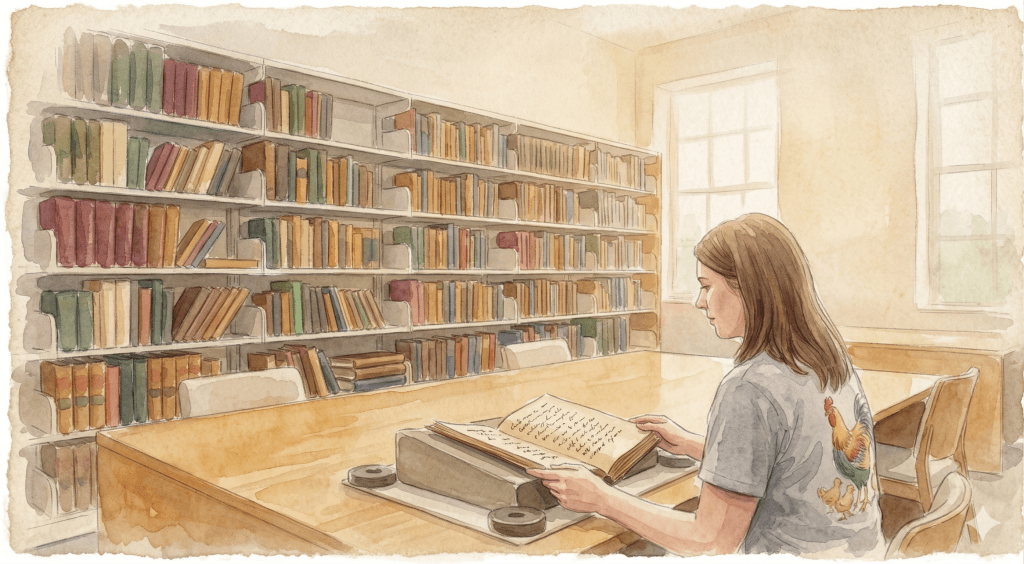
Transcribing and interpreting historical documents is never a solitary business. This project has benefited from the knowledge, patience and generosity of archivists, scholars and technologists who share our enthusiasm for poring over the past.
We are grateful to the archive staff who guided us through heavy volumes and fragile manuscripts, to the authors whose reference works shed light on obscure Latin phrases and legal customsThe rules, rights and obligations by which a particular manor was governed/administered. These customs acquired legal force through long usage... In full., and to those whose technology transformed handwritten pages into (almost) intelligible text. We hope this page may also prove a useful resource for others embarking on similar research.
Archives
The primary research draws on documents held at five archives.
- The National Archives (TNA), Kew, Richmond, Surrey TW9 4DU
- Dorset History Centre (DHC), Bridport Rd, Dorchester DT1 1RP
- Somerset Archives and Local Studies, Somerset Heritage Centre, Brunel Way, Norton Fitzwarren, Taunton, TA2 6SF
- Kresen Kernow, Little Vauxhall, Redruth TR15 1AS
- Hertfordshire Archives and Local Studies (HALS), Pegs Lane, Hertford, SG13 8EJ
Staff everywhere responded quickly and helpfully to our queries. Particular thanks are due to:
- Dorset History Centre, for permission to use the image on the home page (part of the 1781–1782 Plan of the Estate belonging to the Right Honourable Henry Paget Peter Walter Lord Paget, catalogue reference D-1490/1)
- staff at TNA who helped us navigate the heavy (and sometimes fragile) volumes to locate documents not yet fully catalogued online in Discovery.
We could not have carried out the work without them.
Material from The National Archives is reproduced under the Open Government Licence v3.0. All other archive quotations are reproduced under the fair dealing provisions of the Copyright, Designs and Patents Act 1988 for the purposes of non-commercial research and private study.
Online resources
Several academic projects have been indispensable. The Electronic Sawyer (esawyer.lib.cam.ac.uk), maintained by the University of Cambridge, provides the standard reference texts for the Anglo-Saxon charters. Open Domesday (opendomesday.org) offers a clean, searchable transcription of the 1086 survey. The Inquisitions Post Mortem project (inquisitionspostmortem.ac.uk), run by King’s Digital Lab and the University of Winchester, provided the 1441 extent for Ralph Bussh. British History Online (british-history.ac.uk), published by the Institute of Historical Research, was the source for the Victoria County History entries, printed calendars of state papers, and patent rolls.
Biography entries are drawn from the History of Parliament Online (historyofparliamentonline.org), published by Cambridge University Press on behalf of the History of Parliament Trust.
Reference Works
We have used a number of reference books to resolve queries and validate information during the interpretation of the Latin and summarising wills and inventories. The list is provided on the basis it may be of use to others embarking on a similar project.
For Latin:
- Denis Stuart, Latin for Local and Family Historians (Phillimore, 2000; first published 1995)
- Charlton T. Lewis and C. Short, A Latin Dictionary (Oxford: Clarendon Press, 1879)
- D. P. Simpson, Cassell’s Latin-English Dictionary (Cassell, 1984; first published 1959)
- Charles Trice Martin, The Record Interpreter (Phillimore, 1982; first published 1892)
- R. E. Latham, Revised Mediaeval Latin Word List (Oxford University Press, 1965)
- Janet Morris, A Latin Glossary for Family and Local Historians (Federation of Family History Societies, 1989)
- J. F. Niermeyer, Mediae Latinitatis Lexicon Minus (Leiden: Brill, 1976)
- J. H. Allen and J. B. Greenough, New Latin Grammar (Dover Publications, 2006; first published 1903)
For wills, inventories and legal documents:
- Stuart A. Raymond, Words from Wills and other Probate Records (Federation of Family History Societies, 2004)
- Brooke Westcotte, Making Sense of Latin Documents for Family and Local Historians (The Family History Partnership, 2014)
For historical English:
- The Shorter Oxford English Dictionary on Historical Principles, ed. C. T. Onions, 3rd ed. (Oxford: Clarendon Press, 1973)
- The Middle English Dictionary (quod.lib.umich.edu/m/middle-english-dictionary)
Technology (Artificial Intelligence)
The technology available for transcribing handwritten documents is advancing rapidly. We used Transkribus to create first-draft transcriptions from images; however, we reviewed and revised every draft extensively to create the final transcriptions. All translations and summaries are our own work.
We used Gemini to generate the watercolour illustrations that appear across the site.
We used Claude for drafting and editorial support during the writing process for all content except the summaries of historical documents. All historical research, source verification, and content decisions are the authors’ own.
A note on method
This site is based on documents we have personally read. Where a source has not been directly consulted, that is stated. Assertions that cannot be supported by a verifiable primary or reliable secondary source have been cut, or flagged as uncertain. Gaps in the record are acknowledged as gaps, rather than papered over with speculation.